Showing posts with label seniors. Show all posts

Tuesday, March 25, 2014

Emotional Touch. There's Not Yet An App For That.

Gimme a hug. Give us a sqwunch. Get in here. Hug it out. Slap me five. Slip me some skin. Up high. Down low. Too slow.


Over the last several years, major technological advances have been made in the field of senior care. Families who are separated by thousands of miles are now able to monitor virtually all facets of their aging loved one's lives via the internet. Whether it is a daily medication reminder software or a computer enabled shoe to measure the stability of a senior's gait, sons and daughters rest more easily feeling that they know what is going on with mom and dad.

Many in the senior industry feel that the combination of innovative tools now available and the general reticence of seniors to transition into a facility environment is causing a paradigm shift in the way America approaches aging. It would seem that the justification for living out one's golden years in a nursing home has been rescinded; an intended casualty of the ability to address the physical needs and safety concerns of an aging parent from a distance with minimal cost.

But there exists within the physical world gaps which cannot be filled by the miracle of modern science.

In the 1940's, a Hungarian psychiatrist named Rene Spitz conducted research on the effects of emotional deprivation in infants. Spitz observed children who, for various reasons, had been separated from or denied a loving family and raised instead in an institutional environment. His research noted that while the observed babies' physical needs were being met, the emotional toll of not having any sort of familial affection or compassionate physical touch were catastrophic. By the conclusion of the study, more than one third of the babies had died. After 40 years, 21 of the emotionally neglected children were still living in institutions and most were physically, mentally and socially retarded.

The affect of this sort of cruel deprivation during formulative years is unquestionably debilitating. However, I would suggest that the isolation many seniors face on a daily basis is equally tragic.


Imagine that you are a senior. No longer able to drive, you are fully reliant on paid caregivers for your only live human contact each week. A caregiver comes in on Tuesdays and Fridays with a laundry list of things they have been told by your kids are top priorities; dishes, vacuum, groceries, trash, bathrooms, dusting, prepare a few meals to be easily reheated later and of course...laundry. With a friendly but quick greeting, the caregiver arrives and immediate begins to tackle the mission at hand. Rather than disturb her work, you retreat to your worn beige recliner where you doze off during "The Pioneer Woman," daydreaming about what life must be like on the ranch with Ree and the kids. She leaves as quickly as she arrived, having satisfactorily completed the requisite tasks and reported to your children that all was well with their parent today.

Now imagine an alternative scenario. Your caregiver arrives a couple minutes early with a decaf Chai latte, your favorite Starbucks treat, in hand. Before she even glances at the list of absolute musts, the two of you sit down in the sunroom and talk. You just talk. Maybe you talk about the crazy weather. Maybe you talk about nothing at all. Still, you talk and sip your latte. At one point, the caregiver puts down her cup, gently wraps her warm hands around one of yours and tells you how much she enjoys getting to spend time with you each week. The rest of your time together is a blur. You hate it when it's time for her to leave for the day. During every task she accomplished, you were by her side; helping, instructing, living. There is no need for her to report in to your adult children after today's shift. Instead, you pick up the phone. You can't wait to reach out to the people in your life and tell them all about the day you just enjoyed.

The ability to emotionally connect with people is a God-given gift. Without a certain amount of innate sensitivity, I do not believe it can be successfully taught. I am proud to say that many of the individuals who possess this remarkable gift are a part of our Home Instead family. Some work in nursing homes and facilities. Still others float in and out of our lives disguised as postal employees, baristas, pastors, tellers and grocery store clerks. Despite all of our modern advancements, there is not yet an app for that.






Thursday, March 6, 2014

So You Want To Move Closer To Your Grandkids?


I frequently hear of seniors relocating to be near family. That makes sense. If something were to happen, it stands to reason that a person would want to be surrounded by those who know them best and could theoretically provide the best care. Unfortunately, there is not always a pot of gold at the end of that rainbow and many seniors find themselves in a strange purgatory between family and the unfamiliar.

Even in the most optimal scenario, the realities of adapting to a new environment and routine are daunting. Relocation is a difficult process at any age not simply because of the physical aspects of the transition but for the emotional difficulty of founding new friends as well. I have seen this relocation scenario play out a number of times with eerily similar results.

A grandparent (we will call her Eleanor) relocates to be closer to her family. In the absence of any friends of her own in a new environment, Eleanor's family becomes her only community.  Over time, she begins to feel like an unwanted house guest. She can't put her finger on anything specific at first but with each passing week it becomes clear that relations have begun to sour. Soon Eleanor's adult children begin to clearly resent the fact that their family has gained a new(old) member. Smiles and pleasantries are less frequent on both sides which leads her to feel unappreciated and distanced from the family she gave everything up to be near. Sensing that her welcome has run out, she spends less time with the grandchildren for whom she moved to be near and more time in the cute little townhouse she purchased. Suddenly, the isolation she always feared would find her if she lived far away has located her only a few short blocks from her daughter's family. She never wanted to be a burden but a burden is exactly what she feels like.

Certainly there are seniors who manage to make late life transitions work. Unfortunately, they are the exception and not the rule. So here are four quick and easy guidelines for making transitions work for everyone.

1. Set Babysitting Boundaries-

Young children not only add stress to a marriage, they can critically complicate a multi-generational living situation. Set clear parameters for healthy interaction AND distance. Openly and honestly discuss the role you each want to play in each other's life. For some, Sunday lunch and babysitting once a month may be plenty to foster the relationship and preserve the wanted family dynamic. For others, interaction may be much more or less frequent. In either scenario, have this talk with both adult child and adult child's spouse before making a move of any kind.

2. Design Your New Life-

If you can remember that high school boy/girlfriend whose world revolved around you then you understand the importance of having a life of your own. The activities you enjoyed in a previous community should be deliberately cultivated in a new environment. Sit down with your family and establish a plan to engage in the community of which you are going to become a part. From bridge clubs to swimming, soup kitchens to church groups; it is vital that a grandparent be actively engaged in something other than just the life of their family.

3.Take A Vacation...To Your Old Life-

The bonds which have been formed over decades should not simply be cast aside when a move occurs. In many instances, that is the unintended result. Like any relationship, old friendships must be intentionally cultivated in person. Deliberately set dates on which you will return to spend time with your old friends and neighbors. Let nothing prevent you from honoring these commitments. Make sure that your adult children understand and are similarly dedicated to helping you maintain your connection to the life you are leaving behind.

4. Family Meetings-

Take your adult child and their spouse out to dinner once or twice a year (sans kids) in order to continually cultivate an open dialogue. Use this as an opportunity to express your gratitude for the active role they are playing in helping you age successfully. Revisit the plan you created to stay accountable or amend it as needed. Listen to each other and understand that the family dynamic will constantly change as everyone ages together. 


A multi-generational family can be a tremendous blessing to everyone involved. Making it work requires a significant initial investment of both time and vulnerability as well as the careful tending of master gardener. If you choose to plant the seeds, you can't be afraid to get your hands a little dirty.

Wednesday, February 19, 2014

The Reality of Discrimination

http://blog.aimvic.com.au/2012/08/06/leon-gettler-age-discrimination/

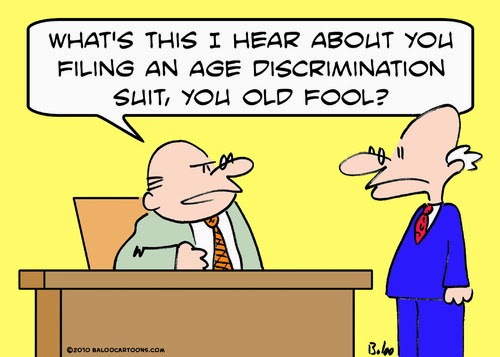
Recently, there has been considerable hub-ub in the media about age discrimination. According to a recent article on MSN Money, job hunters over the age of 55 report having a difficult time landing a job. On average, older job hunters reported spending 47 weeks looking for employment before finally landing a gig.

Federal laws protecting anyone north of 40 yrs against discrimination have been on the books since 1967. In spite of our well intentioned efforts, discrimination against older adults continues to thrive in this country.

Can we have a grown up conversation about discrimination? A real conversation where everyone puts on their big-boy(girl) pants and agrees not to throw a temper tantrum if they don't like what they read?

Discrimination exists.
-What?!
-How dare you!
-Of all the...!
-I am taking my toys and going home!

Phew. Now that we are rid of those people we may continue.

I openly discriminate. I discriminate in my daily life. Last night I was approaching the check out lines at Super Target. One checker was clearly superior to the other options. One checker had multiple piercings and tattoos. One checker was a female. One checker was African-American. One checker was older. One checker looked to have been a member of some sort of Bieber-cult. I surmised my options and discriminated. It would serve no purpose to tell you which lane I chose nor which checker was working my selected lane. After all, you have undoubtedly exercised the same tactics of discrimination and fully understand the scene I am describing.

While it may be unpopular to admit, I discriminate as a business owner as well. I discriminate against the tardy, the slovenly, the inarticulate, the way-too-casual-for-a-job-interview, the resumees that havint bin pruufred and the Dutch.


Of course I realize that sort of discrimination is not the issue at hand. Age discrimination according the Age Discrimination in Employment Act of 1967 only refers to the discrimination of persons older than 40. Could it be that in senior care, as in life, that sort of discrimination is a really good thing?

DISCRIMINATION- [dih-skrim-uh-ney-shuh n]
noun
1. the act or instance of making a distinction
2. the treatment or consideration of, or making a distinction in favor of or against, a person or thing based on the group, class, or category to which that person belongs rather than on inidividual merit.
3. the power of making fine distinctions

Scene: A young lady walks into my office and wants to become a caregiver. I greet her upon arrival and proceed to conduct an interview. Through the interview it becomes abundantly clear that she has never worked with seniors, has little if any relevant experience and is unable to cook anything more advanced than Ramen noodles. Say it any way you want in order to make it more politically correct, she is just too young to be a caregiver.

In fairness, there are those younger persons who have wisdom beyond their years and go on to make phenomenal caregivers. (My wife jokes that I have been an 76 yr old man since my 19th birthday.)

Scene: An older man walks into my office and wants to become a caregiver. I greet him upon arrival and proceed to conduct an interview. He was a caregiver for his late wife for many years prior to her passing. He is a war veteran with a passion for history and volunteers at his local food pantry three times a week. Say it any way you want in order to make it politically correct, his age helps to make him a prime candidate.

In both instances, I have exercised discrimination. If I were hiring computer programmers for the latest social media gizmo the outcomes would likely be reversed and I could potentially find myself in the cross-hairs of the EEOC. But why? Why do we claim discrimination when it does us wrong and never admit when it serves us well?


At Home Instead Senior Care- Chapel Hill, we are proud to say that we practice discrimination. We actively seek mature CAREGivers who know what it is to grow older and have a passion for people struggling to maintain their independence. We are in desperate need of family members who, older or younger than 40yrs, have seen the difference that a great CAREGiver can make. We know the impact that we are able to make if we exercise discrimination. Additionally, we know the cost of turning a blind eye to the red flags which present themselves during our screening process. If I were in need of in-home care in Chapel Hill for a family member or loved one, I would expect nothing less.


Friday, October 4, 2013

The Heart of Home Instead


Allow me the privilege of bragging on my people for a moment.


From the beginning of my journey with Home Instead, I have been blessed to be surrounded with fantastic people. I have worked to intentionally create a culture in which exceeding the expectations of everyone you encounter is the way we do business. This is much easier to do when the people who comprise your family come already equipped with a heart for service. Despite six years of watching caregivers and office staff go above and beyond for their clients, there are still days like today when I come across someone doing something for a client that takes my breath away.

One of the clients we serve has an immediate family member who has recently been diagnosed with cancer. In this instance, it appears that the cancer was detected early enough to be treated successfully with surgery and chemotherapy. Nevertheless, anyone who's life has been touched by cancer can tell you that just hearing that ugly word is terrifying regardless of the prognosis for recovery. My thought upon hearing the news was that we need to send a nice 'get well soon' card and perhaps some flowers. Lenore, our staffing coordinator, had other ideas. She approached me about the possibility of putting together a chemo bag to be taken into the treatment room. Chemotherapy can be an hours long affair where many have nothing to do aside from reading a magazine and contemplating the ominous nature of their affliction. I told Lenore that a chemo bag sounded like a wonderful idea and that I was excited to see what she came up with.

When the bag was completed, it was a thing of beauty. Full of knick-knacks like crossword books, an aromatherapy shrug, comfy socks, peppermint candies, a throw blanket, etc. There was, however, one thing in the bag which didn't make any sense to me. Included in the collection was a package of plastic forks, spoons, and knives. What? I asked Lenore about this particular item and she was fully prepared to answer. "I did some research on some common side effects from chemotherapy. Many people complain about a metallic taste in their mouth which is only made worse by using regular forks and knives to eat. A lot of people have found that using plastic utensils during chemotherapy helps out tremendously. Is that ok that I put that in?"

Are you kidding me? A member of my office staff took it upon herself to not only put together a chemo bag for the family member of a client but actually did research into common side effects of chemotherapy and solutions. Wow.

That, dear readers, is the heart of Home Instead. That is the company that I always hoped we would be and that it seems we have indeed become. That is the way that we are called to love and care for the people of our community. Selflessly. Thoughtfully. Sincerely. That is Home Instead.

Thank you Lenore. I am proud to call you a member of our Home Instead family.

Friday, September 6, 2013

Facebook Can Lead to Depression


Forgive me father for I have sinned. I have joined the despised group of technological addicts who can go nowhere and do nothing without the company of their smart phone. I really don't know how it all happened. Not so very long ago, I had a dumbphone. Facebook was something that I would check on an actual computer at the end of the day to see what my friends had been up to. Suddenly, I find myself thrilled to see the "New Stories" graphic flash across the top of my iphone screen. What wonderful update could my network of friends have for me that wasn't available 13 minutes ago? A funny link? Another low quality picture of someone else's kid complete with their assertion that he/she is the cutest kid ever? Or a request for me to unfriend you? (By that I mean an invitation to play Candy Crush Saga. I will unfriend you. Seriously.) Facebook is sort of like a car accident. Appauling or not, passersby can't help but stop and stare. Twitter is the same accident only with a traffic cop urging everyone, "Move along, only 140 characters, nothing to see here."

The senior population is among the fastest growing demographics on social media. During the summer months, I teach "Facebook for Non-Teenagers" classes at the local senior centers. I thought I was offering a public service but according to new research I could potentially be opening a window  of despair. A study conducted jointly by two German Universities found that facebook can cause envy and trigger feelings of loneliness and depression. "The researchers found that one in three people felt worse after visiting the site and more dissatisfied with their lives, while people who browsed without contributing were affected the most." If the conclusions of the research are accurate then people who have nothing to contribute should stay off of facebook for their own good.

 http://www.huffingtonpost.com/2013/01/22/facebook-study-envy_n_2526549.html

Tuesday, August 20, 2013

So You Think You Can Dance


I am not ashamed to say that I am a reality TV junkie. I don't find there to be much programming on TV worth watching these days but I do have several favorite shows and virtually all of them fall into the reality TV category. Near the top of my DVR list is Fox's hit, So You Think You Can Dance.

In the show, pairs of dancers are asked every week to pair with a new choreographer and learn a new dance in a new style. For example, a classically trained ballerina and a hip hop dancer with no formal dance education will be paired together for a Viennese waltz. It is captivating.

While I watch it strictly to "ooh" and "ahh" at the feats displayed each week, there are benefits to dance which go far beyond entertainment. According to an article in yesterday's USA Today, dance offers some incredible benefits to seniors who are struggling with cognitive impairment and Alzheimer's.

 Enjoy!


http://www.usatoday.com/story/news/nation/2013/08/19/health-dance-art-alzheimers/2674973/